Letters from Our Teachers
Letters from Our Teachers 1 | Letters from Our Teachers 2 | Letters from Our Teachers 3
Letters from Our Students | Email Mayron | Privacy Notice

Emails to Colleen and Her Answers
Subject: Curriculum questions
Good morning. I started teaching group piano classes in the fall at a public school. Two classes are beginning (few had any background knowledge) with 17-18 students at 9 pianos. The third class is 'intermediate/advanced' with many musical knowledge gaps, even after piano class with another teacher last year and previous years. I taught elementary music for nine years and also have piano teaching experience with small groups of three, four and five year old children.When I was offered this job I did my research on teaching group piano as I did not want my students to be given a piece at the beginning of each semester to perform at the end of the semester. I want them to learn. I found your method and ordered the books for my classroom. They have been learning a lot and I have been pleased with their progress, having moved at least halfway through the older beginner level one books. My principal, however, does not see it this way. Even though all he has seen was a 30-minute portion of a one and a half hour class at the end of last semester. Having never been in my room all year, I was shocked when he did not think I was doing my job correctly. I know that I am and when I started to try things his way, my classes fell apart. I am trying to build from the ground up, which your method does, and I feel as though I'm being told to build a building starting at the third story and then the fifth story, and so on. The online method being used in the classroom before I arrived does this.
My question, if all of this makes sense and you can possibly give me any advice, is how do I convince administration that the method I am using is the best way for the students to actually learn music theory and piano? I was unprepared to back up my choice of method since I was blindsided in our meeting with him thinking the students weren't progressing. If I taught in my own studio, whether group or individual lessons, I would use this method. It is the only one that progresses at the proper pace and that builds the foundation needed to succeed in piano.
Thank you.
Allison O.Allison,
WHEW!!! What a conundrum!!! You are teaching under the auspices of an administrator who obviously knows nothing about the learning process in music!!! Here is my advice: Tell him/her exactly what you said in your email below. You are building a foundation of musical knowledge. It's much like teaching any other subject--like math for instance. A math teacher does not introduce students to numbers zero-through-nine and jump to algebra 16 weeks later. A foundation must be laid! You may also tell the administrator that teaching one composition in a school term may make the teacher look good at the final performance, but it short-changes the students who take that music class to learn to play the piano. And please tell him/her that the previously taught students in that school came to your piano classes with tremendous holes in their knowledge. You are trying to re-teach all the information that they did not learn previously.
I am going to forward your email to daughter Colleen. She has a master's in education and can offer great insights. --MayronAllison,
I agree with everything Mayron said and would like to add to it:
Learning to read music and play the piano is literally learning a new language. You must take the time to build a strong foundation then gradually build into more complex conversation. Would your principal walk into a first year Spanish class and chastise the teacher for the fact that the students are not yet reading poetry? He wants you to take first year Spanish students and spend all year teaching them to memorize one poem in Spanish. At the end of the year that poem will sound quite impressive to the principal and parents, but would the students know how to speak Spanish? No.
Would the students have a strong foundation of first year vocabulary on which to build future knowledge of the language? No.
Will the students get frustrated and bored enough to drop out of the Spanish class? Yes.As a piano teacher, you must start with the basics of the language of reading music and gradually build from there. Our method is a student centered learning environment which starts at the very beginning of the knowledge pyramid and gradually builds all the way to the college level. It is because we take the time to build such a foundation that our method is the only piano method that takes students from kindergarten to college.
Hope this helps,
Colleen
Subject: Grouping Student of Similar Ages
When grouping similar ages, would it be ok to combine a 10 and 12 year old. I usually group a year a part for younger students but wanted to know your experience with this age group. I have siblings this age that are interested in taking and didn't know if I could place them together. Thoughts are appreciated.
Jeanie HighJeanie,
Well, the 10 year old will have trouble keeping up with the 12 year old, and older siblings have been known to belittle the younger sibling who is struggling simply because of the age difference. So, you could do one of two things:
- Explain your concern to the parents and start out with them in a class together but be aware of any struggling or belittling. If that occurs, separate them into private lessons.
- If they are the only 2 students in the class, I would do what I call a "one-room school house" which I have done with siblings before and it worked out well, but my siblings were in drastically different levels. They still have the 45 minute class, but you spend 15 minutes with one student while the other student is doing worksheets or practicing quietly, then for the next 15 minutes you switch, then for the last 15 minutes you play a game. I would explain to them and the parent why you are not teaching them together, and put the 10 year old in 1A with he 12 year old in Older Beginner 1 so they won't feel like they should be on the same page.
Hope this helps.--Colleen
Subject: Pricing Group Lessons
I am addressing my pricing as I look to switch to group lessons in the fall. In some ways I feel like I should decrease my rate since I'm adding more students per hour- which increases my hourly income. However, I also feel like I should keep my rates the same as they are getting an hour lesson instead of a 30 minute lesson. What are your thoughts and what has been successful in your studio?
T.FIf you charge less for group classes then you are telling parents that you feel group classes are inferior to private lessons. If you feel classes are inferior, then your parents and students will feel that group classes are inferior. Quite the opposite is true: students excel faster in group, they practice more, they are more enthusiastic about sticking with piano, they become better sight-readers, they count rhythm perfectly, etc.
--ColleenT.F.: Thanks so much for the input! So... Then, do you charge any fees on top of that?? Registration fee, recital fee, book fee, material fees??
I discuss book fees and registration fees in my "Creating Your Teaching Schedule and Student Contract Webinar." I you will find it helpful. -- Colleen
Subject: Private vs Group Lessons
I still haven't been able to move past the "private lessons are better than group lessons" mentality of most of my parents. I'm curious how you explain this to your parents, Colleen.
M.L.
We have some Mayron Cole Piano Method brochures at my Registration Open House, and I refer parents to the overview of The Mayron Cole Piano Method video which explains the benefits of group piano.
I also tell parents who doubt the benefits of group piano something like:The question shouldn't be, "Why do we now teach in groups?" The question should be, "Why did we ever teach privately when everything else, including how to do brain surgery, is taught in a class?"
"Answer, we taught piano privately because of the piano itself; it is a big, loud, and expensive instrument that a teacher could only afford one of. If you only have one piano, you can only teach one student at a time. Now that we have affordable, volume-controllable digital pianos, we can finally teach piano in groups just like we teach everything else to children in groups. Children love engaging in an activity with their friends; there is unsaid peer pressure to keep up with friends in piano class, therefore group piano students practice more; children often learn better from each other than from an adult; we get to play games which reinforce theory concepts; we get to play ensembles which students love plus ensembles and group classes require students to count rhythm perfectly and to keep going when they make a mistake. We teach in groups simply because it provides a stronger piano education for the students, something I talk about in my webinar 'Converting a Private Lesson Studio to Group Piano.' We no longer send telegrams, we no longer travel on horseback, we no longer read by candlelight, we no longer put leaches on sick people, and we no longer teach private piano lessons."
Can you tell how much I love teaching in groups?
--ColleenGreat stuff, Colleen! Hope you don't mind if all of us copy and paste your ideas into our parent emails and conversations! Checking out your YouTube video now. Thanks for all the supportive material!!
M.LI don't mind if you use my verbiage if you teach The Mayron Cole Piano Method! --Colleen
Thank you, thank you!! The Mayron Cole method has always been, and continues to be, so supportive to their teachers.
M.L.
Subject: Beginner Ensembles for 3-4 Students
Do you know of a book I can purchase for my students (I prefer an actual book, not pages I have to print off) that is only ensembles for 3-4 students? In varying levels, I need beginning, level 1 and 2 mostly.
C.C.Many of our beginning level books have ensembles scattered throughout the book:
Blast Off with Piano has six pre-staff note reading ensembles included in the student book;
Menehune has five pre-staff note reading ensembles included in the student book;
Level 1B has three ensembles;
Older Beginner 1 has three ensembles;
Older Beginner 2 has three ensembles.We have a couple of intermediate and advanced ensembles included in our textbooks:
Level 6B has an ensemble
Level 8B has one ensemble.We also have 55 ensembles that can be purchased individually:
Primer level ensembles (#8);
Beginner level ensembles (#7);
Intermediate level ensembles (#24);
Advanced level ensembles (#16).Most ensembles are at one level since all students in a piano class are all the same level, but we do have two multi-level ensembles:
Patriotic Medley Ensemble includes parts for levels 5-9;
Silent Night Ensemble inclides parts for levels 3 & 4.Another option for you is that our beginner level ensembles all come with teacher's part. I very often have an intermediate or advanced student play the teacher's part with the beginners for an all-student performance.
There is also a webinar "How to Teach Ensembles".
Just wanted to add that The Mayron Cole Piano Method has orchestrations on CD, midi, or mp3 for almost all of our products which really help when students are learning ensembles. Hope this helps. Please let me know if you have any questions. -- Colleen
Subject: Webinar Videos
What would your best recommended video be to watch?
H.J.Can you give me more details as to what you are wanting more information about? That will help me narrow down which webinar would be best for you.
--ColleenI've been teaching up to a Level 1 Conservatory level in groups for about 15 yrs so I think I have a handle on that -- would like to do more groups once they're past that stage.
H.J.You might want to check out my webinar "How to Teach Intermediate and Advanced Classes." Hope this helps.
--ColleenThanks for sharing your knowledge!
H.J.You're so welcome. Please let me know if you have any questions.
--Colleen
Subj: Group vs Private Lesson Benefits for the Child
I am planning on moving as many of my students as possible to group lessons. But, I have a few parents who are worried that their child won't get the benefits of private lessons. Can anyone send me a link that talks about group vs. private lessons? I have not taught group lessons, yet, and so I'm not strong on promoting the benefits of this concept. TIA!!!
S.A.We have a "Converting a Private Lesson Studio to Group Piano" webinar that you might find helpful. Plus, we have the Mayron Cole Piano Method Brochure that you can give to parents which explains the benefits of group piano. We also have a YouTube video that tells about The Mayron Cole Piano Method which also talks about the benefits of group piano.
--Colleen
Subject: Partner Lessons
As a private lesson teacher only (for nearly 25 years), I'm weighing whether offering partner lessons is something I want to try. My studio is overflowing, and the wait list has grown all year. I hate to have to send that potential income away if only a few time slots come available. I don't have time to do a major studio curriculum revision and teach in 3s or 4s, but with good planning, I think I could do partners. Keeping all of my private students and adding some partner lessons to the mix is what I'm looking at -- for now.
J.B.Two is a group, so you can teach them just like you would teach a class of 3 or 4. You will find group piano is so much fun for you and the kids! Best of luck with this new change to your studio! Keep us posted on how it's going. --Colleen
Subject: Recital Slideshow
Each year at my spring recital I run a slideshow of all our events throughout the year. I always include photos from the previous summer camps. The slideshow is always a hit and it absolutely helps increase camp attendance!
S.W.Love this idea! Wish I had taken more photos throughout this year. --Colleen
Subject: Memorization
Do you require your students to memorize their recital songs?
T.S.
I require students to have their music in front of them at the recital even if they have memorized it. If they panic during the performance, then they have their music to refer to so they can keep going. Keeps the recital fun and low stress for the students. -- Colleen
Subject: Scheduling
How do you schedule groups with siblings of different ages/levels? Do the parents make multiple trips?
B.H.I teach in a small town, so some of my students only travel a few blocks while students who live on ranches travel up to half an hour for lessons. I usually try to schedule siblings in back-to-back classes, but when I can't make it work for everyone, I at least try to put those who travel the furthest in back-to-back classes. Usually texting parents while scheduling helps. I also give preference to students who have been taking the longest. Hope this helps. --Colleen
Subject: Teaching Different Levels in the Same Group Lesson
I am seriously thinking of turning my studio of 81 private students into a group format. I have a waiting list and have been thinking of hiring another teacher, but groups will allow me to cut down a little bit on my crazy hours, yet still take on more students. I also follow ... (someone else) ... who also went from private to a group format. But his groups are a different set up than any of the others. He actually has different levels in the same group and rotates around the class to instruct them privately... I would really love to hear some opinions about this set up.
M.P.Teaching a group to multiple levels is just teaching multiple private lessons simultaneously. IMHO, that type of teaching meets the needs of the teacher rather than meeting the needs of the students. The group piano teaching created by Mayron Cole teaches to a class just like a class at school. We don't recommend teaching to the middle, which is something I address in my webinar titled "Teaching Slow/ Accelerated and Transfer Students."
When teaching to a class that is all at the same level, the students receive a stronger piano education than in a private lesson because there is unsaid peer pressure to practice ("my friend will be able to play this at next week's lesson, so I want to be able to play it too"). Students also learn to keep perfect rhythm because almost all piano playing during class is as a group, even from the very first lesson. Game time and theory fun sheets completed together as a group reinforce concepts, and ensembles are just FUN!
To quote Mayron Cole, "Almost 40 years ago when I was teaching piano in Houston, I decided to place some students with the same piano playing abilities in small groups and teach all of them at the same time. Surprisingly, the group piano classes created an unexpected surge in enthusiasm and lesson preparation by the students. I could easily see that the group taught students were becoming stronger musicians than my few remaining privately taught students. The group students’ rhythm counting and sight-reading skills were superior in every way! I wasn’t aware of it at the time, but those first group piano students were also testing all of the music for the thousands of students who would eventually study from my books.” --ColleenM.P.: Thank you so much for all your great thoughts on this subject, Colleen! The one thing you said that sticks out in my head is that the method "teaches to a class just like a class at school." Since I am not a fan of public school and how classes are run (and I am the parent of an accelerated, average and special needs child), I have seen all angles of it and studied it extensively. So much of what a child does in their lives is group oriented. I don't necessarily think having some individual attention is such a bad idea. I am a huge fan of vertical learning, as opposed to horizontal learning (the school model where all ages stay in the same grade together)... I think it is important for me to keep an open mind and if something isn't working, no matter how much time I have put into it, be willing to change it and try something new!
Yes, I did say that our method "teaches to a class just like a class at school," but I also said, "We don't recommend teaching to the middle, which is something I address in my webinar." I agree that the public school system is broken. Their problems arise from classes that are too large and forcing curriculum to move forward at a pre-set pace.
Two issues that are not a part of The Mayron Cole Piano Method groups. Our classes are a student centered environment which progress at the pace of the students, plus the small class size allows for personal attention during each lesson.
I agree that a vertically based class is advantageous, and I actually incorporate a vertical approach to returning students. After the first year of getting to know the students, I can schedule subsequent years based on their learning style and pace, not just on age. There are so many factors involved in creating the optimal environment for our students, and it's wonderful that we have this forum to bounce ideas off each other. Keep us posted on how your group classes progress. --Colleen
Subject: Make-up Lessons!!?
I'm planning on moving to a makeup policy... I have a studio of 15 students, so I'm not sure how often canceled lesson slots would be available, and I would also like to offer video lessons and group lessons every other month. I'm concerned about what will happen if myself or my daughter is sick and I have to cancel lessons for one or two days. Thoughts?
S.C.I have never given a make-up lesson. Do parents expect the soccer coach to show up on Saturday morning and teach a private practice to their child just because the parent decided to go to a spaghetti supper at the church instead of taking the child to soccer pracitce? Heck no. You train people how to treat you; the parent is paying for my time for 45 minutes each week during their assigned lesson time whether they show up for the lesson or not.
I state in my policy:
"No tuition credits or make-up lessons are given. The Colleen Cole Conservatory is giving each student 2 FREE lessons, so the student may miss two classes without any cost to the parent. Therefore, please do not send sick children to piano or guitar class."
About the 2 free lessons, my school year course is 32 lessons, they pay for 30. In 16 years of teaching group piano,I have never had a parent who had an issue with this policy. If I have to cancel because I'm sick, I add a lesson at the end of the school year. For more info, check out my webinar titled "Creating Your Teaching Schedule and Student Contract" Hope this helps. --Colleen
Subject: Too Much Time on Making Assignments
As I'm looking to transition to weekly group lessons in the fall, I'm wondering if you have suggestions for how I could streamline giving my students assignments each week?... I feel like as a private teacher I spend a LOT of time writing notes and things for the student to work on during our lesson time. I just won't be able to keep that up with 5 children in one class. What other ideas do you have?... I'm not sure about typing up all the assignments ahead of time? What if we don't get to something?
C.C.The first year I taught group piano, I printed the homework out on stickers ahead of time. However, each week I either felt stressed out rushing to get through all of the material even when the kids were struggling with it, or I felt stressed out knowing that I was boring the kids by stretching out an assignment that they learned more quickly than I thought. Group piano classes need to be a student centered learning environment that moves at the class' pace rather than your pace.
So in the subsequent 15 years of teaching group piano, I have printed out a page that says on the front and back "HOMEWORK: PRACTICE ALL MUSIC FROM HERE TO THE END OF THE BINDER TWO TIMES EACH DAY UNTIL YOUR NEXT LESSON." I put that page in a plastic page protector so it will last all school year. Then each week while I am pulling out the new looseleaf pages (The Mayron Cole Piano Method textbooks are available in loose leaf to help keep the whole class working on the same assignment), I tell the students to move their homework page to the back of their binder, which even my first grade students can do on their own after the first few weeks. I then hand them the pages that I plan for us to go through and they place them behind the assignment page. If we go through the music faster than I thought, I just hand out the next few pages and we keep learning. If we don't get through as much music as I thought we would, I have them take out the pages we didn't go through and I keep them for next week. Hope this helps. --Colleen
Subject: Piano Discovery Camp
I am thinking of adding a piano discovery camp for little ones this summer. Any curriculum you'd recommend? I can come up with my own curriculum, but I'd rather not reinvent the wheel. Thanks in advance!
S.D.For your "little ones,"ages 5 & 6, The Mayron Cole Piano Method has a Blast Off Jr course which is a 5 lesson summer camp intro to piano. We have a webinar dedicated just to marketing and teaching Blast Off; we also have a teacher's manual and orchestrated accompaniments.
Hope this helps. ----Colleen
Subject: Changing from private lessons to group lessons
I am transitioning over the summer to group for all my beginners, Level 1 and Level 2. I'm looking to make a few investments for my studio to make this transition -- what would be the BEST use of my money? I will still be based out of my home and am thinking of investing in 1 decent keyboard. (I have access to 2 others + my piano for class, so this would make 4.) What are your favorite games? What other items do you think I should consider, other items I might not think about because I've only been doing private lessons up until now?
C.C.The Mayron Cole Piano Method has a "Staring a Group Piano Studio from Scratch Webinar" that discusses all of the equipment and supplies that you'll need, along with talking about some of the business issues that you'll need to address when running a group piano studio. We also carry a "Studio Start-Up Kit" that has all of the beginning level teacher's manuals, accompaniments, games, audition book, etc.
Hope this helps. Let me know if you have any other questions.
--Colleen
Subject: Piano/Music Camp
Do you have experience running a 5 day piano/music camp with full days instead of just mornings or just afternoons? Am I completely insane for tackling this as a first-timer? My very early research is showing that parents in my area like full week/full day camps so they can keep their school-aged children busy throughout the summer.
L.F.
I recommend you take a look at our operettas. Students don't need any piano experience to perform the show. In your camp, you can spend as much time as you want on choreographing the dances, designing costumes, and making scenery. You could even combine the operetta camp with a Blast Off course. I would do Blast Off for 45 minutes at the beginning of the day, then spend the rest of the day on the operetta. I would also have some piano-type movies standing by in case students get tired of working all day. "Beethoven Lived Upstairs" is a great movie for kids of all ages.
--Colleen
Subject: "Parented" classes
Colleen,
Would you do all parented or non-parented classes?
H.J.I'm not sure what you mean by "all parented" classes, but I assume you mean a class in which the parents attend along with the child. My answer to that is a resounding "NO." First of all the parent is paying for one piano lesson; if the parent attends with the child, then that parent is also learning to play the piano, but you are not getting payed for the additional student. Second, having the parent in the room causes discipline issues for the child. When the child misbehaves, who corrects him/her? The parent isn't going to correct the child in YOUR class, but you can't exactly correct the child's behavior while the parent is sitting there acting as if the behavior is acceptable. Furthermore, we had a teacher call us one time in tears saying that a parent had sat through the child's class for an entire year, then turned around and opened her own group piano studio and took most of this teacher's students! Remember, we train people how to treat us, so in the first class of the school year when parents bring new students in to the studio, I sweetly turn to the parent and say, "You can pick him up at 5:30." The parent says "ok" and leaves. Hope this helps.
Thanks,
Colleen
Subject: Writing A Proposal for Mayron Cole Group Piano Method
Hello,
I am writing a proposal to teach your method of group piano classes at a local Fine Arts Institution. I hope you can help me answer several questions:1) Do you recommend a certain brand of keyboard for beginners?
We do not recommend any special brand. _____ has some good keyboards with standard-size keys. Please do NOT purchase the "teacher's headphone console." It is not necessary and hampers teaching by isolating you from the students.
I understand that they need to be regular sized keys, but not necessarily 88 keys.
The keyboards do not need 88 keys if you are teaching mostly beginners.
2) Please spell out the order of progression through the books from the very beginning for me.
We have 22 piano method textbooks plus the two Blast Off books.
Here is the order of progression:
- Blast Off With Piano Junior (for 5 & 6 year old beginners)
One-week summer course; students graduate into EZ Keys; after completion of EZ Keys, they graduate into Menehune Music. - Blast Off With Piano (for 7,8,9,10 year old beginners)
One-week summer course; students graduate into Level 1A. - EZ Keys - (for 5 & 6 year old beinners who can read)
- Menehune Music - (for 7 year old beginners; a bit more difficult than EZ Keys)
- Level 1A - (for 7, 8, 9 year old beginners and for graduates of Menehune Music)
- Level 1B - Graduates of Level 1B go into Level 2A.
- Older Beginner Level 1 (for beginning students age 10 and older)
Older Beginner 1 is an accelerated course that teaches all the concepts that are covered in Level 1A & Level 1B. - Level 2A
- Level 2B Graduates of Level 2B go into Level 3A
- Older Beginner Level 2
Older Beginner 2 is an accelerated course that teaches all the concepts that are covered in Level 2A & 2B; it is for students age 10 and older who have completed OB1; graduates of OB2 are ready move into Level 3A. - Level 3A
- Level 3B
- Level 4A
- Level 4B
- Level 5A
- Level 5B
- Level 6A
- Level 6B
- Level 7A
- Level 7B
- Level 8A
- Level 8B
- Level 9A
- Level 9B (This book is not completed yet. Should be ready by the summer)
The higher level books are pre-college books.
3) Is Mayron planning to write any more Operettas?
Mayron has written four operettas: Jack & The Beanstalk; Toy Shop Christmas; Magic Meadow; and Cinderella. She is in the process of re-writing Cinderella so don't order it just now. We have no plans to write any more operettas.
They are one of my selling points to the Fine Arts Education program I am soliciting. They love the idea, because the operettas teach Drama as well as all of the other disciplines.
What fun our operettas would be for the music and drama students together!
4) Our education program fundctions in two terms of 12 week classes every year, plus a summer camp.
You can use Blast Off Junior (Ages 5 & 6) and Blast Off (Ages 7 - 10) in the summer. Depending on the children's ages, they would begin either Level 1A or Menehune in the fall. Students already in the program do our ensembles, solos, opetettas, & supplemental music at their level during the summer such as our Summer Stunners & Level 1 Folk Song Favorites.
Thank you for your time!
Judi H. (FL)
Colleen,
So would it be correct to say that taking Blast Off during the summer can save an entire year of
instruction in EZ Keys or Menehune, by going straight into Level 1A? Then, if a student does NOT take
Blast Off, place them by age in either EZ or Menehune? I think I'm getting it.
Thank you, Judi
The music in Blast Off Jr is from EZ Keys, so going through both books would be redundant.
Blast Off Jr graduates go into 1A;
Blast Off graduates go into 1A;
EZ Keys graduates go into 1A;
Menehune Music graduates go into 1A.
Colleen
Ok, I think I've got it now! I just wanted to make sure I understood it all properly,
because I will need to be able to explain it to the education VP. Thank you for the extended explanation.
Judi
Judi,
Blast Off Jr graduates will spend the first few weeks in the pre-staff note pages at the beginning of 1A.
EZ Keys and Menehune are each approx 15 lessons, not full year courses.
Graduates of EZ Keys and Menehune can either skip the first few pages of 1A or quickly move through them as a review.
So there is really only a few lessons difference between Blast Off Jr to 1A and EZ Keys/Menehune to 1A.
Another option for Blast Off Jr graduates is to go into our Menehune Folk Song Favorites or Menehune Classical Favorites book
for a few lessons to give them more time with the pre-staff note reading before starting 1A.
A further option for Blast Off Jr graduates, is to put them inBlast Off which has six 3 or 4 piano ensembles that the kids really love to play together.
Lots of choices, all of them good. There is no wrong answer here.
The key is to give young students time to absorb rhythm counting and the keys on the piano before
moving into staff note reading.
EZ Keys and Menehune go into more depth with the pre-staff note reading instruction; but we had many customers who needed a short summer course for students; so we created Blast Off Jr which covers the same information but in less detail.
Whether you use Blast Off Jr, EZ Keys, or Menehune your young students will have a strong pre-staff note reading foundation upon which to build.
Young students who go into Level 1A either from Blast Off Jr, EZ Keys, or Menehune will move through 1A much more slowly than 8 or 9 year old students.
Hope these additional comments help. Please let me know if you have any other questions.
Thanks,
Colleen
Subject: Recent Book Revisions
A number of years ago I bought some books and materials for teaching your method. My question is - Is the material in the EZ Keys books still the same? Your pictures are different on the website. Menehune too?
P. P.
Dear P.P.,
We revised the EZ Keys book in 2008 and 2010. The music is the same as it always was, but it has been re-typset. We also added theory fun sheets. I believe those 2 revisions occured in the 2008 edition. If memory serves, the only change we made in 2010 was the cover art and page numbers. Basically, if your EZ Keys has theory fun sheets, then the book you have is the same as it is now; only the cover and the page numbers have changed.
We revised the Menehune book in 2010 as well. We changed the cover (we have actually updated all of our overs) and the page numbers. We also added three ensembles. If the book you have has 3 ensembles at the end of it, then it is the updated version. The cover and page numbers might be different, but the rest of the content is the same.
Please let me know if you have any other questions.
Thanks!
Colleen
Subject: Forgotten Music & Studio Policy
Yesterday, while viewing your dvd a few questions came to my mind and I would be grateful for your input as you have time.
Studio Policy: My astute daughter, Colleen, has often said, "We train people in how they are to treat us!" She is correct! And now you have to un-train those folks. You need a copy of my studio POLICY. And, when you create your own studio policy you must ask the parents to read the policy... and sign and date that they understand it and will abide by it. If a parent will NOT sign the policy then you should not take that student since you are being forewarned that the parent is going to push you around.
Forgotten Music: In the policy, hopefully, you will state that no lesson will be taught if the student "forgets" his music. How can a parent drive to a piano lesson knowing the child does NOT have her music? That has always puzzled me! I did loan my Teacher's Copy to a student and she wrote all over it answering the theory questions! That really steamed me! Put a sign on your studio door:
Reminder: No piano lesson is taught to a student who forgets her music.
Go over that portion of the policy (above) with each parent if they come in person to sign-up for piano lessons. If you mail or email them your policy, highlight that section with a yellow highlighter. You can pin a note to the Policy stating that you will be enforcing the following "rules" and you want all parents to be aware of the new rules.
Make-up Lessons: Again, put this in writing and highlight it when you send the policy to parents. If you allow yourself to be talked into giving a make-up lesson after you have stated in your POLICY that you will not give make-up lessons---then you have broken your own policy and it is null and void. I told several parents this fact when they started getting pushie about make-up lessons. I told them that it was out of my hands since we had both agreed, in writing that there would be no make-up lessons, and the parent had signed and dated that she would comply with that rule. That settled the matter!
Subject: "Note Finder"
Dear Mayron & Colleen,
Catherine,
Here's where you can get one, Catherine: http://www.samash.com/wright-way-note-finder-wrightnot . They last for only about a year, but they are very useful, especially in placing new students.
-Mayron
Subject: Student Placement
Hi Mayron and Colleen,
Also, this coming school year, I plan to teach some of the same students as last year. My Level 1A (ages 9-11) class from last year did not finish their book because having a fall and spring recital slowed down giving new assignments. This is OK! That's why we identify each book as a LEVEL and not a YEAR. Some really good classes often complete two levels a school year. (Mayron)
Since this was my first year to teach group lessons, I felt like they needed more time reviewing pieces instead of learning some new concepts. I have learned that focusing on just having a spring recital will be better. We came close to the end but had a few more weeks left. My question is this: If my two older students from the Summer Blast Off program are interested in this coming fall, could I place them in my Level B class with my other older group? No, please do NOT do this! The "new" students in the Level B class will not know enough to stay up with the other students. I would encourage the two older students who have completed your summer Blast Off Course to refer some of their friends to your piano classes--that way your two Blast Off Graduates and the new friends can begin Level 1A at the same time. Also, put out word around your church, school, etc., that you have a new Level 1A class beginning in September that is open for 9-10 year olds. But, again, do NOT combine these Blast Off graduates with a class beginning Level 1B. (Mayron)
Especially if one of the 2 students decides not to take this fall, I would have a hard time fitting that child in a class because of their age. Tell the mother of the one remaining student that you will put that child on your "wait" list until more children her age sign up for piano. Then, do it! Don't start a "class" in the fall with only one child in it. And have some faith--most parents don't look for a piano teacher until late August or early September. You should get more calls as the summer ends. (Mayron)
I am trying not to teach private lessons anymore. My time is limited. This coming school year, my younger Level 1A class ages range from (7-9)yrs.Also, I advertise that I teach ages 6-12 yrs of age. I have 5 piano keyboards and one teacher keyboard. My classes are limited and I am trying to teach all classes on one day. Just trying to make better use of my schedule. Amen! All we can "sell" to our customers is our time and our talent. But once the "time" is gone--it is gone! We must schedule our time as best we can! (Mayron)
Mayron,
Thank you!
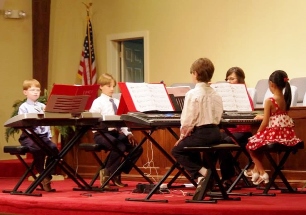
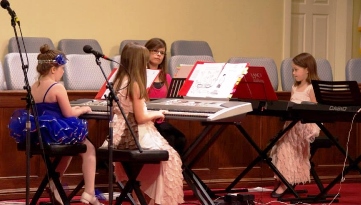
Here are a couple of pics of our Spring Recital Performance this year (2013)at our church. Hope you enjoy!
Subject: Teaching Myself Piano
Hi,
I am 62 years and self teaching myself with some online help from various places and have also had a few (frustrating) private piano lessons. Your site seems geared toward teachers wanting to establish group teaching classes or studios. I just want to learn to play piano the best way before I'm dead.
Is this method one I can teach myself and use at home on my own? I have used a beginner book with CD that has (as you say skipped quickly through the basics) taught me to play but not well. I can't count, can't do one thing with one hand and something completely different with the other, can't read music well, can't play without fingering guides and am frustrated. My teacher keeps saying this is all really easy stuff, but it has not been for me. I am not willing to give up yet.
Will your course help? Where should I start?
Thanks,
J....(CA)
Hi, J.......!
Wow! What an interesting email from you. All of the problems you have mentioned with your progress in learning to play the piano are problems that my piano method addresses. Yes, my method was written for group piano classes originally, but we took an informal survey a few years back and have found that about 40% of our customers use my
piano method in teaching private lesson students.
If you have an iPad, you can find two of my Beginner Level books on it with orchestrated accompaniments at the iTunes store. Several people have contacted me and told me that they are teaching themselves with this iPad music. On your iPad, go to the iTunes store and key in Piano Made Easy. You would want order the Beginner 1
book. Accompaniments are included.
If you do NOT have an iPad, you should purchase my Older Beginner Level 1 book plus the CD on my website. I think you can teach yourself with my piano method since it goes slowly and everything is explained multiple times. Please contact me again after you have tried my piano method and let me know
how you are doing.
I wish you the best! And--playing the piano is not a mystery. Once you understand what to do, it makes sense--I promise!- I think my piano method
will effectively show/tell you what to do.
-Mayron
Subject: Requesting More Info About Method
I saw the note in your order asking for more information about our method, so I wanted to get back to you about that.
1) Our website has quite a bit of information for teachers that are new to our method: www.MCpiano.com .
2) Here are some links to overview videos about our method:
http://www.youtube.com/watch?v=JmJMhu9HMjU&feature=context-gau
http://www.youtube.com/watch?v=qokmy69Mzdc&feature=context-gau
http://www.youtube.com/watch?v=BoMy8XVWnUU&feature=context-gau
3) We also have individual videos that show a few pages from each textbook in our method. You can access those from the description page of each textbook on our website (for example: http://group-piano-method.mcpiano.com/level-1a--complete-student-book-p115.aspx ) or you can access them from the YouTube links above.
4) We have many webinars to help teachers that are new to our method:
http://group-piano-method.mcpiano.com/piano-teacher-training-seminars-c50.aspx
5) The Student Audition Book that you just purchased is also a good introduction to our method. In that book, you will see one page of music from each level, so you will be able to see how our method progresses. Of course, the Audition Book does not have any of the theory sheets that are in our textbooks, but the overview videos (#3 above) will show you some of those.
Hope this helps! Please let me know if you have any other questions.
Thanks.
Colleen
In reading your webpage, I have some questions about the method. I have been a successful teacher for many years and am not throwing out one method to exclusively begin another but like to explore other options. In fact, many years ago I attended a seminar with Mayron in Kansas City.
First of all, how many do you consider a "group" and do I need a keyboard for every student?
Secondly, if students learn ONLY in a group, how do they play alone? Is the music in parts and therefore the student does not have the entire piece?
I will have a group of beginners this fall and may like to experiment to see what would happen if I started this group exclusively in a group lesson format.
A.M.
A.M.,
Thanks for your interest in The Mayron Cole Piano Method. To answer your questions:
First of all, how many do you consider a "group" and do I need a keyboard for every student?
A "group" would be more than one. Most group piano instructors teach 4 - 8 students in a class. Sometimes, you will find that you only have 2 or 3 that you can put together. As soon as students start reading staff notes in Level 1A, you will need a keyboard for each student in the class. Before they begin reading staff notes (textbooks: Blast Off, Blast Off Jr, EZ Keys, Menehune), you can put two students at each keyboard.
Secondly, if students learn ONLY in a group, how do they play alone? Is the music in parts and therefore the student does not have the entire piece?
The students all have the full piece of music. In class, the group learns the piece together just like subjects taught in school. They play that piece alone at home and at times for you in class. It is only when the class is playing an ensemble, that the students have and play just a portion of the piece. I think these videos will help answer your question: http://www.youtube.com/watch?v=BoMy8XVWnUU&feature=g-upl and http://www.youtube.com/watch?v=JmJMhu9HMjU&feature=context-gau
Please let me know if you have any other questions.
Thanks.
Colleen
Subject: Interested in converting to group lessons....how to get started?
I am a piano teacher interested in converting to a group method this Fall. I've scoured your website, but I am a bit overwhelmed about how to get started. Are there any materials I could browse before diving in? I looked at the recommended starter kit, but I would like to get some help before actually purchasing anything. Right now, I'm not sure my parents will be interested in this, so I have questions about the best way to convert, how to sell it to parents, and then how to actually teach it. Any help you can provide would be appreciated.
Thanks in advance!
K. C.
K.C.,
Thanks for your interest in The Mayron Cole Piano Method.
If you are not ready for the Studio Start-Up Kit, then there are a few other items that would help you get a general overview of our method.
Teaching the Early Levels Seminar on DVD is a 3 hour seminar that covers how to teach in groups and how to handle some of the business aspects of a group piano studio. Mayron covers a bit from all of our beginning level text books.
Converting a Private Lesson Studio to Group Piano Webinar discusses how to keep private lesson students and parents happy while you convert your studio to group piano.
Older Beginner Level 1 and Older Beginner Level 2 textbooks. Even if you are planning to teach younger students, taking a look at these 2 textbooks will give you a good idea about the first two levels of our piano method. We have a 14 day return policy less a $4 restocking fee per order if you decide you do not want to keep the books.
The Student Audition Book gives you one page of music from each textbook so you get an overview of how the method progresses from one level to the next. Again, this book has a 14 return policy.
Other than that, I would recommend a couple of overview videos that we have online: http://www.youtube.com/watch?v=JmJMhu9HMjU .
|
This video discusses which concepts are covered in each level of The Mayron Cole Piano Method. The Mayron Cole Piano Method is the only piano method that takes students from kindergarten to college. …
|
 |
Hope this helps. Please let me know if you have any other questions or need anything else.
Thanks!
Colleen
Subject: Questions about public school classes and our iPad App
Mayron & Colleen,
I'm sure you get e-mails all day that have just a few questions, so I will try to keep this brief!
Yes, we do receive many emails with questions from teachers. But we are always glad to give information to all of you when you need it.
I am planning to start teaching classes for the first time when school starts again this fall:
First, our school district uses a modified year round schedule. Do you have any suggestions for this?
Most of the teachers who use our material offer a 32 lesson course from Sept to May. Thirty lessons and two class recitals=32.
I am planning to basically follow their schedule to fit in the 32 classes, but that means several longer (2-3 week) breaks throughout the year.
During the 2-3 week breaks, give the class "homework" to learn before they come back to school.
Second, I have noticed that each of your books do not have the same number of suggested lessons. For instance, Menehune has 33 lessons and 1A has 20. Is this method not designed to finish 1 level a year? I just need some clarification on that. Obviously, I could add supplemental stuff for the shorter books, but wasn't sure what you had in mind.
When students have completed Level 1A (twenty lessons), they then begin on Level 1B. Most complete all of Level 1A and 1B in one school year of 32 lessons. The complete series of 1A + 1B is designed for one 9-month, 2-semester teaching year.
Third, I have several families with siblings in them. With other methods I always recommended that we reuse all of their books but theory, thereby keeping their costs down. Is it possible to just buy the theory pages of your books to insert in the binder?
No, the music theory that we include comes with the music to be studied in each lesson. Our theory is not sold separately. However, if your school uses iPads, your students may download Older Beginner Level 1 and Older Beginner Level 2 onto their iPads and the theory can be erased and reused many times by many different siblings. Within a few years, we will have all nine levels of our music downloaded for use on iPads.
Lastly, what is included with Operetta orders? Do I have to order one for each of my students or does it come with all the parts?
Each operetta book contains the narrator's part, the piano music, and the stage direction for the actors. All cast members need to know what the other cast members are doing. We have great CDs for our operettas that really add a lot to it. The children learn the piano music on their own (mostly) but do not play keyboards/piano at the presentation. The CD is used instead.
I am really excited to start teaching with your method. I have almost filled all of my classes and haven't even had to do any advertising, word of mouth has done my work for me!
Yea! I wish you lots of luck! I think you are going to enjoy teaching our material! -- Mayron
Thanks for all the help.
L. P.
Subject: Question about Blast Off
Colleen & Mayron,
I've been teaching your group piano for a few years now and it's going
great. I take kids straight from Kindermusik into Level 1A. I have one
class that is about to graduate from Kindermusik and they would like to
do a little summer program. They'll be starting 1A in fall. Should I
use Blast Off or Blast Off Junior?
I have not seen either of the Blast Off books or teacher books.
Thank you!
K. S.
Hi, K.S.
I'd use the regular Blast Off With Piano for those Kindermusik graduates. (There is a Blast Off Teacher Manual plus an accompaniment CD.) Blast Off Junior might be too easy for them.
Best wishes!--Mayron
SUBJECT: Missing the 2nd Lesson
Hi Colleen,
I need to ask your advice. I have 3 little girls in myLevel 1A course. They all three came the first time last week but this second week 1 of them didn't come for some reason. I just don't know how to handle this. If I don't teach her alone before next lesson, how will she possibly understand CDE when she has never had them?? What would you do? I know you have said to tell them to pick up their music and learn it on their own but I don't possibly see how she could do that so early on....
J.S.
J.S.,
It's always difficult when someone misses one of the first lessons. People are surprised that the first few lessons are the most important. When you get further into the curriculum it won't be such a big deal when someone misses.
At next week's lesson after you hear everyone's homework, do a review. "Let's show Sally what we learned last week. Everyone play all of the Ds on your piano." While the other 2 girls are playing all of the D's, show Sally where the D key is. Do the same for the other keys. Of course at game time be sure to review these keys with her. She will be learning new keys as well today. When you get to the pianos, go through at least one of the songs from last week. You can assign that piece again to the whole class; it never hurts to review. Then learn the new songs. It is ok if you do not get through all of the pieces you had planned on for this week. That will give you next week to still be working on the pre-staff note music so everyone will be really good at recognizing the keys.
At the end of the class, have her mom come in and say that she learned a lot of information today because she learned everything from this week and last week. Show the mom the key drill and have her do that with her daughter at home this week to help her catch up: "Play all of the Ds on your piano. Play all of the As on your piano." etc. Tell her it is important that she does not do the keys in alphabetical order; mix 'em up. Even if the mom does not know how to play the piano, she can look in the book to see which key is which.
Colleen
Wow! What a tremendous help you are! Thanks so much!!
J.S.
Subject: New Older Beginner Series in 2011
Can you tell me the difference between the new Older Beginner Series and the New Older Beginner Series, please?
Thank you,
B. M.
Dear B.M.,
Old Older Beginner Series:
Older Beginner A = Level 1A
Older Beginner B = Level 1B + the first half of Level 2A
Older Beginner C = last half of Level 2A + all of Level 2B
New Older Beginner Series:
Older Beginner Level 1 = Level 1A + Level 1B
Older Beginner Level 2 = Level 2A + Level 2B
Plus the new Older Beginner Series looks GREAT!
Please let me know if you have any other questions.
Thanks.
Colleen
Subject: Free Samples
Hello. I received a flyer in the mail about your method and just watched the free video on youtube. Is there anyway to get a free sample of your material?
Thank you!
S
. W.
Dear S. W.,
Thanks for your interest in The Mayron Cole Piano Method.
We have just added a new feature to our website where you may see each of our beginning level books online. In our online store on the webpage for each book, please scroll down to the box titled "summary". The top line in that box says "Click here to view 14 pages from the student book." That link will take you to a YouTube page that will display a virtual tour for you. The video is best viewed in full screen mode so you can see each page clearly.We added this feature for the following beginning level books in late June 2011:
1) Blast Off with Piano,
2) Blast Off with Piano Junior,
3) EZ Keys,
4) Menehune,
5) Level 1A,
6) Level 1B,
7) Older Beginner 1,
8) Older Beginner 2 ,
9) Level 2A ,
10) Level 2B,
11) Level 3A,
12) Level 3B,
13) Level 4A,
14) Level 4B,
15) Level 5A,
16) Level 5B,
17) Level 6A,
18) Level 6B,
19) Level 7A,
20) Level 7B,
21) Level 8A, &
22) Level 8B.
Please let me know if you have any other questions.
Thanks.
Colleen
SUBJECT: Getting Started With The Correct Teaching Materials
Dear Mrs. Cole or Staff,
1) Is there a way to determine the slower piano learner from the faster learner at the very start so as to put them in different groups right from the beginning? If I have many 7 year olds, for example, who have never had lessons, how do I decide what students will do well together?
2) In looking at your catalog, I did not see Teacher Manuals after LEVEL 1-B. Is this information included in the student books, or what do you recommend?
3) Also I noticed in the catalog, that there appear to be no Teacher Accompaniments Books after LEVEL 3. Do you recommend that the teacher play along with the CDs at this point?
4) Outside of the Training DVD’s, what do you think would be best for me to purchase to get a good overview of the whole program? I would like to know what to expect from each level.
Thank you so much for your help!!
D. N.
D. N.,
Thanks for your interest in The Mayron Cole Piano Method. To answer your questions:
1) There is no way to pre-determine the speed at which a student will progress. However if you have the time, you could teach your 7 year olds our Blast Off program each afternoon for one week during the summer. By the end of that week, you will know which students progress more quickly or slowly than others which will help you determine your school year schedule.
2) We carry Teacher's Manuals from Blast Off Junior through Level 1-B. After a teacher has taken our training seminars and/or webinars and taught the beginning levels using our teacher's manuals, teaching the subsequent levels is self explanatory.
If you would like more information about teaching the various levels, we have the following recurring, hosted Webinars:
Teaching Blast Off and Blast Off Jr (introductory summer course)
Teaching EZ Keys and Menehune (Pre-Staff Note Reading)
Teaching Level 1
Teaching Levels 2 and 3
Teaching the Intermediate and Advanced Levels
How to Teach Ensembles
3) We offer additional teacher's accompaniments through Level 2 & Level 3. By Level 4, the student part is a full composition that does not need any embellishment. Starting in Level 4, you can play the student part along with the student if you wish. We have USB FLASH DRIVES, CD's, & SMF Floppy Disk orchestrated accompaniments for all material up through Level 6 with more to come. Have students play with the orchestration or with your accompaniment... whatever works best for you.
4) We are in the process of creating a video that is an overview of our method. We hope to have that online within the next week (br May 27, 2011) and will put it on YouTube with a link on the homepage of our website.
In the meantime, in our web store when you are looking at a product, there is a description that states what concepts are covered in that level.
Another way to see a small overview of our method is to purchase our "Student Audition Book." The Audition Book has one page from each text book so you can see how the music progresses from one level to the next.
Please let me know if you have any other questions or need anything else.
Thanks.
Colleen
SUBJECT: Interested In Product
Hello, my name is L. D. and I am currently teaching piano in an after school program here in _________, grades preK-8th. I am looking for something better than what I am currently using. Sometimes I have 3-5 students or just one at a time. I need a price quote for your entire program for kids and what you think would work best for my situation. Mainly my students are in 3rd-6th grade. Things I find are lacking in my students are theory skill and remembering the name of notes. Also, to add our school economic level is very low. Only 3 students have a place to practice at home. Please help!!!
Thanks for your interest in The Mayron Cole Piano Method.
The price of your program will depend on how many students you have and which teaching aide products you decide to purchase (ie: games and teacher's manuals). The prices for all of our products are on our website at www.MCpiano.com. If you purchase more than 25 products at full price, you will receive a 10% discount.
I would recommend you start the 3rd and 4th graders in the Level 1A; the 5th and 6th graders in Older Beginner Level 1. These books are $19.95 each, or you may purchase the 1A book in 3 partial books for $6.95 each... please see our website for details. Each student will need his/her own textbook (our products are copyrighted so they may not be photocopied).
Our method is classical approach so it is very strong in theory, note recognition, and site-reading which is why we are the only piano method that takes students from kindergarten to college.
Please let me know if you have any questions or need anything else.
Thanks!
Colleen
SUBJECT: New Class Piano Lab
Hello Mayron and Colleen,
My name is A.R., and I am a music teacher in _______. I have music degrees from _______ University; a BM in Piano Performance and an MM in Piano Performance and Pedagogy. During my years at _______ University, I had lots of experience teaching both private and group piano lessons, to music majors as well as non-majors, and even children through our piano lab. Now that I’m all “grown up” and on my own, I am teaching at a brand new charter school in _________. Our headmaster is extremely supportive of the development of a fine-arts program here at _______ Academy….he wants the arts program to be established BEFORE athletics! Amazing, right??? Well, we have recently been given a very generous gift. A donor provided the funds for us to furnish our school with a brand new piano lab. I am absolutely thrilled and am so excited to begin class piano here at our new school! I have been researching class piano methods, and, while I wasn’t previously familiar with your method, am impressed by what I see. I have been tasked with the job of figuring out the breakdown of our new classes and finding a curriculum that will meet the needs of many students. Your method seems to fit the bill.
However, before we make the investment into your program, I do have some questions that I hope you’ll be able to answer.
First, in all my searching through the items on your website, I can’t seem to find a good representation of many of the “classics” from the basic piano repertoire….I read where you say you have selected pieces from the standard repertoire, but I can’t find them. Are they integrated into each level? Are they age appropriate for each level? Do you cover topics such as lives of the great composers simultaneously as a piece is being taught?
How often do you offer training seminars? I’d love to attend one, if you offer them frequently….
Our piano lab has 10 student keyboards plus 1 teacher keyboard. Our standard class size is 18-20, so I am looking at teaching each grade (4th, 5th, 6th) in 2 groups DURING the school day, as part of their music class. I, personally, believe that the entire student body (pre-k through 6th grade) could benefit from class piano, but my headmaster is afraid that the students won’t have enough time to complete their core class studies during the day if we take EVERYONE out for 2 music classes per week (one class piano class and one general music class). Do you have an opinion on this? It has been suggested to me that anyone younger than 4th grade could have the option of taking class piano, but outside of the school day, and thus, for an additional fee.
I’m certain that I will have other questions, but these are the few that are burning in my mind at this moment. I would really appreciate any advice you can offer, and hope that my brand-new, cutting –edge piano lab will soon be using your curriculum! Hope to hear from you soon!
Sincerely,
A. R.
Thanks for your interest in The Mayron Cole Piano Method. Sounds like you work at a wonderful school! To answer your questions:
1) We incorporate classics into the textbooks. In the early levels there are a few arrangements of classics and the students start playing some unabridged versions in Level 3. On our website, there is a list of all of the music in each book. While in the description of the book, at the bottom of the "Summary" box, you will see a link titled "List of Music in This Book." That will give you more details about which classics are taught in each level. There are some music history stories in the books as well, but if memory serves, most of those stories are in levels 4 and higher. For the early beginners, we have a pre-staff note reading book titled "Menehune Classical Favorites Beethoven" with 5 stories form his life and arrangements of 10 compositions.
2) We currently have 2 seminars available on DVD... "Starting a Group Piano Studio from Scratch" and "Teaching the Early Levels of The Mayron Cole Piano Method." Also, starting in April, we will be offering live webinars. We have not announced them and do not have exact times, yet, but I think they will be offered every two weeks at least through mid-summer. Some of the webinars we will offer will be:
"How to Market and Teach Blast Off with Piano and Blast Off with Piano, Jr"
"Starting a Group Piano Studio from Scratch"
"Ideas for Summer"
"Creating Your Teaching Schedule and Student Contract"
among others
We will post information on our homepage as soon as we get them scheduled.
3) 4th, 5th, and 6th graders are very fun to teach and progress quickly with piano. As for the younger students, if your school cannot work piano lessons into their schedule, then after school classes for anyone who is interested is a great option. Keep in mind that when your younger students reach 4th grade when you teach piano to everyone, those that took piano after school will be at a very different level than the beginners. You'll need to plan ahead for the need to split the piano classes by piano playing abilities at that age. But, that is a few years down the road.
Please let me know if you have any other questions.
Thanks!
Colleen
SUBJECT: Summer Teaching Options & Music Choices for Advanced Students
Hello,
I have a few questions regarding using your course. The first has to do with summer lessons. Do most teachers using your course just not teach during the summer other than doing Blast-Off? Or do they do some kind of supplementary material? I am assuming that because during the summer attendance will be sporadic that you can't really continue with the regular curriculum. The next question has to do with the older, more advanced students.
As a private teacher I have discovered that once they reach a certain level and age they have the desire to choose their own music, usually pop or classical. Second: How do you handle teaching individual pieces in a group session? I look forward to your answer.
Thanks,
D.T.
D.T.,
I would guess that most of our teachers teach some during the summer. You are correct that not all students will sign up for summer piano and you will want to keep classes together in the fall, so in the summer you can teach music that is not in the textbooks. We have quite a few options for summer classes:
---For EZ Keys, Menehune, and Blast Off With Piano students we have Sing-A-Long Favorites Folks Songs books. We also have a Summer Stunners book and a more advanced Sing-A-Long Solos book for Level 1A and Level 1-B students.
---For multi-level summer classes, we have quite a few operettas which are fun to perform for parents and friends during the last class of summer. We also have ensembles for beginners and ensembles for more advanced students which are fun to perform during the last class.
---For levels 5 and up we have a music writing course titled "Compose Yourself."
---For advanced students who have picked out music that they want to learn, summer class is the perfect time for that! All students learn all of the individual pieces in the group. If 4 students select four pieces, all students learn all 4 pieces together. Many students prefer the original solos by Mayron Cole.
Please let me know if you have any other questions.
Thanks!
Colleen
SUBJECT: Teacher's manual; maximum class size; & varying abitities in students?
Hello,
I have been teaching piano privately for about 27 years, and never thought much about class lessons. I took a piano class once in college, but the class and teacher was hooked up to headphones. Recently, a school asked me to develop and teach piano classes, which has lead me to your website. I was particularly impressed with the first bit of advice that you had about not teaching individuals, but letting the whole crew go along for the ride. I am interested in learning more about your method. Do you have a sample teacher's' manual you could send me? The first days of sign-up had incredible results, with around 15 students. I hope to add many schools to my schedule. I was also wondering what the recommended maximum class size should be. And also, what do you do with varying abilities in students? Eventually some will pull out ahead, or some will have difficulty. Do you split off kids into more advanced classes?
D.B.
D.B.,
Thanks for your interest in The Mayron Cole Piano Method.
It sounds like the piano "class" you took in college was multiple private lessons being taught simultaneously. That is not the type of class we recommend teaching. Our piano classes are taught just like all other school classes: the entire class is working on the same page together while the teacher instructs the class as a whole.
We do not send out samples, but we do have a 14 day return policy for books bought at full price (there is a $4 restocking fee). In addition, we have a sample page of each of our products on our webstore. When looking at the description of the item, click on "view enlarged image" to see the full page. We also have a training seminar titled "Teaching the Early Levels of The Mayron Cole Piano Method" on DVD that you might find helpful.
Your class size should be as many students that you feel comfortable teaching. Most of our group piano teachers have class sizes of 4 to 8, although we do have some school teachers who teach as many as 25 at one time!
As for students that move at a different pace, everyone is expected to keep up with the class (just like a school class). Anyone who does not do their piano homework is now behind and has to work to catch up. Teach the class at the pace of the best students; do not slow down good students to accommodate a student who is not practicing.
Please let me know if you have any other questions.
Colleen
SUBJECT: Grouping high school students in piano classes.
Hello!
I currently started teaching band and chorus at a high school with a piano lab. It is a fledgling program, and the previous teacher ordered adult, private instruction books as opposed to class piano books. Also, all students were grouped together despite their skill level. I have students who cannot read music at all grouped with students who are composing 2-handed pieces. How would you suggest I approach this situation and differentiate my instruction?
Thank you,
A. M.
A. M.,
Thanks for your interest in The Mayron Cole Piano Method.
The only way for group piano classes to be successful is for everyone in the class to be at the same piano playing level. Just like with a math class, you cannot have some students studying first grade math while others are studying 8th grade math. If students of various piano levels are grouped together, you end up teaching multiple simultaneous private lessons rather than teaching a class. Try to re-schedule your classes and group them by piano playing level.
Please let me know if you have any other questions.
Colleen
SUBJECT: After EZ Keys, then what?
Good morning,
I have two kindergarten students who are just finishing up EZ Keys (they've done very, very well!) and are ready to move onto the next level. I had originally thought they would move on and do the quick course at the Menehune level, which is suggested in one of my teacher guides. However, in another teacher's guide that I have, it recommends that these students move onto Level 1A. What is the correct placement for such students? I'm somewhat confused.
Thank you so much for your help.
My best,
B. L.
B.L.,
There is no right or wrong answer to your question. If you feel they need more time with the pre-staff note reading, then you could put them in Menehune, the pre-staff note Sing-A-Long Favorites, or the Menehune Classical Favorites Beethoven book. If you feel they are ready to start reading staff notes then you should put them in Level 1A. Since you said they did very well in EZ Keys, I would recommend that you put them in Level 1A. Children that young will progress slowly in Level 1A, but that is okay. Just let the class progress at the natural pace for those students.
Please let me know if you have any other questions.
Thanks.
Colleen
SUBJECT: Where do I start?
Colleen,
Hi there! I'm a music teacher and am just starting to do group lessons with 8 keyboards. This is new to me and it sounds like you have been there before. I just jumped in, too!! I really want this to successful and I want the students excited. I guess it just takes time and experience. I like your website. Where would you recommend I start? And do you have any advice? Thank you soo much!
M. F
M.F.,
Thanks for your interest in The Mayron Cole Piano Method!
As for where to start, it all depends on how much you want to spend. We have a Studio Start-Up Kit which has 20 items (plus a free gift) for new studios for $380 which is $110 off the full price for those items. If you don't want to spend that much, you could purchase any of the items that are in the Studio Start-Up Kit individually. The Teaching the Early Levels of The Mayron Cole Piano Method Training Seminar for $49.95 is very helpful to teachers that are new to our method (it is included in the Studio Start-Up Kit). We also have teacher's manuals for all of our beginning level books (included in the Studio Start-Up Kit). Please visit our storefront at www.MCpiano.com for more details about any of these products.
Please let me know if you have any other questions. We wish you the best of success with your new studio!
Thanks.
Colleen
Mayron,
My daughter told me to email you and tell you that she likes your method best!
My daughter takes piano privately from someone else. When she started taking I didn’t know about your method or I probably wouldn’t have started her in private lessons with the _____ method. She has struggled through _____ and hates it. Even though I am a piano teacher, I have not been able to help her through _____.
I am organizing all my Mayron Cole books for lessons and classes that are starting this week and the next. Today, I let her play through some of your books. She went to her lesson and went on strike and told the teacher she wanted to play out of “mommy’s books.” Of course, the teacher was not too happy about this! She and I feel differently about this. She is afraid that my daughter will not progress fast enough in your method and that it will be too much repetition for her. The teacher has only seen level 1A though so she doesn’t know how it does seem a bit slow in 1A, but by the time they are in the second level, they are far beyond other students at that stage. The teacher and I seem to disagree about a fundamental point- I feel that a child needs that repetition to be able to move on to harder things. I feel like, though she may not realize it, the teacher is coaching her through the pages of the _____ book rather than having her learn it. We talked through this today after her lesson but did not seem to come up with an answer.
I went through this same thing as a child and ended up quitting and starting back in high school. The only difference was that with me, it was ______ and _______ that I hated.
I am at a loss of what to do at this point. I would rather her be switched to your method. but at the same time I don’t want her taking from a teacher who doesn’t quite understand it. If she teaches it just like she would teach ____ it won’t be much different. The teacher would probably be very offended if I loaned her the Mayron Cole training DVD! I don’t have any spaces open in my classes to teach her in my group classes. And I have actually hired another teacher who is going to do your training DVD and teach with me but her classes are at the same time as my classes so my child can’t go to them. Do you know of any other teachers in Birmingham, Al? Should I try to teach her privately on my own?
L.T
AL
Wow! Lauren!
Thank you and your daughter for your loyalty to our piano method! ........
As to "what to do": I agree with you that asking your daughter's teacher to switch to our piano method would probably cause tension between that the teacher, you and your daughter. If it were me, I would purchase another keyboard for my piano classes and put your daughter in my piano class. Or, do the same with the other teacher who will be working for you. Just add another keyboard. I could tell you ghastly stories of transfer students who have come into my music school from other methods. One little girl could find the G keys above and below Middle C but didn't know that there were many other G keys on the keyboard. I was trying to put her into a beginning Level 2 class (which starts on G2 below middle C, as you know!) She was so stressed that there were tears! She had had THREE YEARS OF PIANO LESSONS when she transferred into my school. It turns out, she didn't know how to count rhythms, either. Her mother said, "No wonder practicing was so traumatic for her. She doesn't know anything!" The teacher had been playing the music for the child, and the child merely copied what she saw. She had no understanding of music! After consulting with her mother, we decided to put her back into a Level 1 class. She loved it and stayed with piano for six more years! She became a good little pianist! Let me know what you think of adding the extra keyboard to your class.
--Mayron
Lauren,
Wanted to throw in my 2 cents worth, as well.
I definitely agree with Mayron. Have your daughter take from you; make room for her in one of your classes. I took from Mayron (my mom), and I loved it! I would walk down the hall for my class with my friends... it was wonderful! I don't think a private lesson with "mom" would be as successful as a group.
As for our Level 1A moving slower than "the other methods," in our method we take the time to build a strong foundation upon which a student can grow into an accomplished pianist. Other methods have big results at the beginning because the students rely on reading fingering, yet they can never become accomplished pianists... at some point you have to start moving your hands and you must know how to READ the notes to do so. So, yes, I would agree that our method moves more slowly than others at the beginning and that is one of the wonderful facets of The Mayron Cole Piano Method! Repetition, repetition, repetition building a strong foundation until the information is second nature. With that strong foundation, our students can become very accomplished! As proof, right now our method goes up through Level 7B and Mayron and I are in the process of writing Levels 8 and 9! That will take our students to the college level. No other method goes up that high.
As for the other teacher coaching too much rather than teaching, that is one of the big arguments FOR group piano. Many private lesson teachers hover so closely that they end up telling the student all of the answers. If a schoolteacher gives a student all of the answers in math, the student never learns math. Same goes with piano. By teaching a class, however, the teacher is requiring the student to pay attention, do his/her part, and actually learn the information.
We wish you the best with the upcoming school year. Please let us know if you have any questions or need anything.
Thanks.
Colleen
Mayron,
Thank you for your responses. It is just frustrating to have your own child having trouble! If that is not a testimony against some of these other methods I don’t know what is! I have never personally had this much trouble with _____, and I have taught it for almost 10 years. Most of my _____ students did pretty well- although I will say that I did mix in other methods and literature so that they did not become stuck playing in the hand position or playing by ear. I just started group last January, and this fall I am changing all of my private students to Mayron Cole as well but 2! (one of which is a teenager who is playing only literature, and the other I will change once she is finished with her current book). I wasn’t unhappy with _____, but after having one student who I happened to change to Mayron Cole halfway through Level 2A, I just noticed the difference. This girl is far beyond where she would be if she were in _____.
I will have to finish out the semester with the private lessons since we have a contract. I may be able to add her to one of my classes next week as well. She has been telling the teacher that she wanted to take in group classes from me for at least an entire semester! I just haven’t been sure that she would behave and participate with mom as the teacher. She is 5 and a half, and is in _____ primer. She can read some on the staff- although it is very frustrating to her. Her teacher thinks that Level 1A is too easy for her. However, I think she needs to go back. In fact, I have a Menehune class that I will be starting and I don’t think it would be bad for her to go into that class. I do not have a 1A class. She has been reading for 2 years and tested on a second grade level so reading is not an issue for her. Would you put her in Menehune because it is more developmentally appropriate for her age or 1a since she has already has so much music and can already read?
Lauren,
Put your daughter in our Menehune Music Book. She will love it because it is indeed appropriate for her age! Now she can hone her new music skills instead of constantly being hit with all new material.
We wish you all the very best!
--Mayron
SUBJECT: "Private" Lesson Students
Hi,
I started using your method with a new private student, and I love it. It makes so much sense! I don't have room anywhere to teach a class - but I'm looking! I really love this method.
I recently purchased E-Z Keys for 5-yr-olds. I've been looking it over & wondering if there's a lesson plan for the first lesson. I'm a bit unsure how to introduce it, but I thought I had time to figure it out. This morning I got a call for a new 5-yr-old student. I'm meeting her tomorrow afternoon for her first lesson. Help! Suggestions?
Thanks,
Bev. R.
Bev.,
We have a Teacher's Manual for the EZ Keys book that walks you through what to cover in each each lesson. The manual was written for teaching in a group, but the information you will teach will be the same with a private student (you will just manage your time differently than a group teacher).
Please let me know if you have any other questions.
Thanks!
Colleen
SUBJECT: Starting Group Teaching
Hi,
I’m a private piano teacher who is interested in beginning to teach groups. I am interested in using the Mayron Cole method and would like to know what you recommend as the first step in getting started. I am excited about making this addition to my existing business and look forward to hearing from you.
D. A.
D.A.,
Thanks for your interest in The Mayron Cole Piano Method. The best place to start is our website at www.MCpiano.com. We have quite a bit of information in the site with questions and answers, articles, seminar video clip, etc. If you click on "Storefront" you can look through all of our products.
As to what products to start with, well, it depends on how much you want to spend:
- We have a Studio Start-Up Kit for $380 (discounted from $483) with 20 items that you will need to get your studio started.
- We have a couple of training seminars. Teaching the Early Levels of The Mayron Cole Piano Methodis a 3-hour seminar for $49.95 (it is included in the Studio Start-Up Kit). We also have Starting A Group Piano Studio From Scratch a 45 minute presentation for $19.95.
- As for music, the Level 1A student book for $19.95 is a good place to start. Or, you can purchase the Level 1A Teacher's Manual for $39.95. Both of these items are also included in the Studio Start-Up Kit.
Hope this helps. Please let me know if you have any questions or need anything else.
Thanks.
Colleen
SUBJECTS: Theory Levels & Piano Only Accompaniments
Hello Colleen,
Are you familiar with the California Certificate of Merit leveling? How does your method match up with their leveling?
Hi, T.D.
No, we don't have a convention or any workshops scheduled this year beacuse Mayron and I are swamped with all of new products we are trying to get on the market.
The theory in our method coincides directly with the Texas State Theory Exam for each level. I would think the information would all be similar for all states.
For the piano only accompaniments, take a look at our new USB Flash Drives. They are for use in any computer and come with midi sequencing software. You can turn the various instruments on and off, so you can play along with just the piano if you want. You can also completely control the speed without affecting the pitch. I think it is just the thing your advanced students are looking for.
Please let me know if you have any other questions.
Thanks.
Colleen
SUBJECT: Our CDs are not just for listening.
Colleen,
I received my CD, and I have a question for you. Have you made a CD that's sort of just basic, without all of the other instrutments and just playing piano? The music is nice for listening but, I can't seem to get in it.
Thanks!!!
D.D.
D.D.,
All of our CD accompaniments have multiple instruments playing so that you can enjoy playing along with other musicians while you practice. However, if you order our accompaniments on USB Flash Drive, you can turn off all instruments except the piano. The USB Flash Drive is for use in your computer and comes with the neccessary midi-sequencing computer program. Another great feature about the USB Flash Drive is that you can completely control the speed! So, when you are first learning a piece, you can have it play as slowly as you need it to.
Please let me know if you have any other questions or need anything else.
Thanks.
Colleen
SUBJECT: Adult Beginner Books
Colleen,
I am an older adult (smile) and have just finish your Level 1-A book and I am on line looking for another level up and I am not sure which one. Can you help me with this.
Thanks!!!
D. D.
D.D.,
The next book after Level 1A is Level 1B, however I think you would prefer our Older Beginner series of 3 books which moves faster than the books written for children. You can go straight from Level 1A into Older Beginner B. So, I would recommend Older Beginner B for your next book.
Please let me know if you have any questions or need anything else.
Thanks,
Colleen
SUBJECT: Classical Music, Training DVDs, "Certification," & See Your Materials
Hello,
I’m and a professional harpist and piano and harp instructor and I came across your materials as I was looking for a new opportunity to enhance my teaching studio. So here are a few questions.
--Is classical music incorporated into your program?
--Do I have to be “certified” in your program to use your materials?
--Can I learn the necessary information from the DVD training materials that you have available?
--If I incorporate your materials into my teaching studio, may I also incorporate other materials along side?
--What is the best way to see your program and music books to make an evaluation?
Music is such a wonderful gift to share with students.
I appreciate your help with these questions.
Sincerely,
A.W.
A.W.,
Thanks for your interest in The Mayron Cole Piano Method. Below are my answers to your questions...
--Is classical music incorporated into your program?
Yes. Mayron has interspersed classics along with her originals. She picked classics that would specifically teach the new theory that she presents in the lesson. Of course, most of the classics are in the higher levels, but even Level 1 has a couple of arrangements of classics. We also have a supplemental book of arrangements of Beethoven classics for the little kids (Menehune Classical Favorites). For more details about the classics that are interspersed in the method, please visit our website and in the description of each book there is a list of all of the music in the book. Also, we are actually in the process of re-writing our Level 7 and are creating Levels 8 and 9 as well. All 3 of those levels will be 1/2 classics. We hope to have the new Level 7 out this spring.
--Do I have to be “certified” in your program to use your materials?
No. you don't have to be certified in our method to teach it. We are a music publishing company and are happy to sell or products to anyone who orders. Having said that, we do offer certification for those teachers who want it. The certification is part of the "Teaching the Early Levels "training seminar that we sell.
--Can I learn the necessary information from the DVD training materials that you have available?
Yes. We have 2 DVD products. The "Starting a Group Piano Studio from Scratch" DVD focuses more on what you actually need to do to get your studio up and running as well as a brief overview of our products (not training to teach the method). The "Teaching the Early Levels" DVD is the training seminar Mayron used to give around the country. It will show you how to teach our method in groups. We also offer teacher's manuals that walk you through what to teach at each specific lesson for our beginner books.
--If I incorporate your materials into my teaching studio, may I also incorporate other materials along side?
Yes. You may teach any material that you want. We are a publishing company rather than a franchise, so we are not involved in how you run your studio.
--What is the best way to see your program and music books to make an evaluation?
Our website (www.MCpiano.com) has a ton of information about our products. When you are looking at a specific item, click "View Larger Image" to see a full page from that book. Otherwise, I would suggest you purchase a couple of books to take a look at. If you purchase them at full price, you have up to 14 days to return them for a refund (we don't refund shipping either direction and there is a $4 re-stocking fee per returned order).
Please let me know if you have any other questions or need anything else.
Thanks.
Colleen
Colleen,
Thank you for your quick response to my questions yesterday. Some additional thoughts that I have . . ..
--I see that you have teacher’s manuals for the beginning students but not for the older beginner, level 2 and up.
Is the curriculum geared for the student to take private lessons at the point that they get to level 2?
--Do the materials continue to have theory papers and game activities included with the music for the older beginner and level 2 and up?
--If I am reading correctly, the audio CD, SMF disk, and the new thumb drive all have the same music accompaniments on them—correct? I just need to select the one that fits my studio the best. Obviously the thumb drive is more versatile.
I appreciate your help as I continue to ponder your curriculum.
Sincerely,
A. W.
A. W.,
You are very welcome. We enjoy helping teachers who are new to our method get their studio up and running.
--You will use the 1A Teacher's Manual for Older Beginner A and the 1B Teacher's Manual for the first half of Older Beginner B. We only continue teacher's manuals through Level 1B because that is all our teachers have needed. Once you have taught our method through Level 1B, then you know how to teach our method in groups and can continue through all levels without the need of a manual. Our method was created to be taught in groups even in the higher levels. In fact, I have a class in Level 6A that will be walking in the door at any moment. But, of course the material can also be used for private lessons.
--Yes, the theory pages and game activities continue all the way through Level 6 and soon through Level 7.
--Yes, our 3 types of accompaniments have the same sound files on them. The SMF disk is for use in a sequencer; the CD is for use in any CD player and plays the music at 3 speeds; the flash drive is for use in your computer and comes with midi sequencer software. Of the 3, I would choose the flash drive if you have an old computer available to use in your studio. With a midi sequencer you can completely control the speed which is helpful when the students are first learning a piece of music. The additional benefit of the flash drive is that you don't have to buy a sequencer!
Please let me know if you have any other questions.
Colleen
SUBJECT: Setting-Up My Studio
Hi Colleen,
I've been researching keyboards on the internet, but before I talk to any dealer, I would like to narrow down the options of what I'd buy. I haven't gone to a store to try out a keyboard yet. As of last week, all I could think about was accoustic, so learning about your teaching method is a whole new shift in thinking for me, (and I'm really excited about that).
Here are some Yamaha keyboards that I thought sounded good (all with a pedal jack and touch response keys):
PSR: 225 GM, 260, and 450
PSRE: 303, 313, 403, 413
YPT: 310, 400, 410
If you have any recomendations, please let me know. If there are good models that I've missed, or some that I shouldn't consider, I'd appreciate the heads-up. Also, I believe that you mentioned that you order another brand of foot pedal - I'd love that information as well.
These are all new models, I believe. As I'll probably be ordering up to 10 keyboards, I thought that I'd try a dealer in my city to see what price they'd come up with. (I've never ordered from e-bay, so I don't even know if I could get an order of 10 from one place - if so, I could go that route to save money). If you have good ideas about that, please let me know: I like easy, and you're the one with all the experience.
Thanks again for all your help. I think I've pretty much read everything on your site, and I can't wait to get my Studio start-up kit.
Sincerely,
M. L.
M.,
I personally would stick with the 200 and 300 series. When you get up into the 400 series you are paying for a lot of bells and whistles that you won't need (ie: 500 insturment sounds). I don't know why Yamaha makes so many models, but any of the 200 or 300 series should suffice.
The pedals are Yamaha pedals and you can get them through AmericanMusical.com if your local store doesn't carry them. They are only about $10 each.
Please let me know if you have any other questions.
Thanks!
Colleen
Hi Colleen,
Thanks so much for the help - I feel overwhelmed when it comes to looking at keyboards, so this makes my task much easier.
For getting started, how many keyboards do you think that I should buy for my studio?
I saw pictures on your site with the keyboards sitting on a big table, and kids on either side - that looks like a good idea, because then I wouldn't need to buy stands, and wouldn't have to worry about the keyboards falling over. Is this how you recommend doing it?
Thanks again,.
M.
M.,
...........How many keyboards do you think that I should buy?
Depends on how many students you plan to teach at one time. At the very beginning, you can put 2 kids at each keyboard, but once they start reading staff notes they will each need their own. You could see how many sign up to get an idea of how many you will have in each class and then buy the keyboards; or you could start out with just a few and if you need more then add some later.
............keyboards sitting on a big table?
The table is a good idea. I have 2 studios, one with the keyboards on tables and one with the keyboards on stands. The tables are much easier. But, you have to get a table with adjustable heighth legs. A regular folding table is too high.
Hope this helps. Let me know if you have any other questions.
Colleen
Thanks, Colleen!
All these great tips that you're giving me will make my initiation into group teaching much more pleasurable. I'll look into the table today.
I can see that I'll be introducing this method to other teachers that I know. I've talked to a few teachers already about this course.
Thanks again,
M.
Subject: Fingering
Hello Colleen,
Here (below) is an email comment from a parent on teaching fingering. Would you happen to have any suggestions? I find that many students just don't want to use their first fingers and getting them to follow the correct fingering is such a challenge. I joke that they might be "allergic" to playing with their first fingers and fifth fingers.
Thanks so much.
J.
"Hello J,
I'm happy with the progress B. is making now, so please don't take the following comments as an overcritical parent. I think he needs to learn and pay attention to correct finger position (whatever happened to thumbs on middle-C?). I try to point out to him the finger notations in his music, but he complains and goes right back to using whatever fingers suit him to play the notes. The result is that he rarely strikes any keys with his thumbs or pinky fingers. When do you start reinforcing proper finger position in your classes?
Thanks, K."
J,
The parent that sent you the e-mail was really asking 2 different questions. First, why are you not teaching the student to put both thumbs on middle C? And second, why are you not teaching the student to play with the thumbs and little fingers? I'll address these questions separately.
To answer the first question... The Mayron Cole Piano Method goes to great lengths to NOT train students to always put their thumbs on middle C. If they are locked into that hand position, then they will find it very difficult to ever play more than those 9 keys. Also, when locked into that hand position, those students quickly realise that instead of reading the notes, all they have to do is read the fingering, thus not learning to read notes. The catch is that obviously there are more than 9 keys on a piano. Starting as early as the beginning of Level 2, students will be moving their hands to other parts of the piano. Those that are locked into both thumbs on middle C find it virtually impossible to move past Level 1. Take a look at any advanced piece of music (whether it is in our method or not) and you will realise that if a pianist is locked into only playing certain hand positions - both thumbs on middle C or any of the other short-cut hand positions that are out there - they will NOT be capable of reading advanced music. We as advanced pianist are reading the NOTES, not the fingering, and are prepared to play any key with any finger. We need to train our beginners to also be prepared to play with any finger on any key so they will have to ability to become advanced pianists. By the way, the classical composers never wrote fingering in their manuscripts. Fingering is a recent addition intended only as a helpful tip.
When I teach fingering, I tell the students that when they get more advanced they will be moving their hands to play keys all over the piano. So, the composer uses the fingering numbers as a helpful hint because she knows what is coming up in the music - she knows how many fingers you are going to need to play the upcoming keys. With the fingering numbers the composer is whispering to you, "Psst... in your right hand, you should put your thumb on this E, because three measures from now, you will need to have a finger available to play that B."
As far as requiring students to always play the keys with the finger numbers that are indicated, that comes down to the age and piano level of the student. As beginners, especially young beginners, teach them what the fingering numbers mean. Have them start the piece with the correct fingering, but if they move their hands in the middle of the piece, I suggest you let it slide. The youngters are doinig their best to figure out what the staff notes mean, then push down the correct key, and hold it down for the correct legth of time. That is A LOT of information for a beginner to process. If we start bogging them down with too many details, they will get frustrated and quit - thus never becoming advanced pianists. If beginners know what the fingering means and why it is there, then as they become more advanced and actually need the finger numbers to move their hands, then they'll use them.
The answer to the second question about playing with all 10 fingers completely depends on the age of the student. Young beginners are still learing fine motor skills - they can barely write - so requiring them to use fingers that they naturally don't use could cause the same frustrations as the fingering issue above. So, I would aprroach it the same way as the fingering issue above. At the beginning of a piece, tell the student to put all 10 fingers on the keys. As he/she plays the piece, the thumbs and little fingers might drop off the keys, but I suggest to let that slide. Continue to tell all the beginning students to put all 10 fingers on the keys and as they become more advanced, they will start remembering to play with all of their fingers.
One example of worse case scenario, 4 years ago I had a tiny kindergarten student that didn't play with thumbs or little fingers. For years at the beginning of EVERY piece we played, I told the class to put all 10 fingers on the keys. During every piece we played, her thumbs and little fingers dropped off the piano. But one day the music became so difficult, that without my saying a word, she started using all 10 fingers - try playing a sixth with only 3 fingers! She is now in 4B and plays with perfect hand position. Of course I would have prefered for her to play with perfect hand position from the start, but I knew that when the music hit a certain level of difficulty, she could no longer afford to short herself out of 4 fingers.
If the students are older beginners (I'd say 4th grade or older), yes, go ahead and stress using all 10 fingers form the beginning of their piano career. They are old enough to have control over their fine motor skills and should always play with all 10 fingers.
I know my response is a bit longer than you expected, but fingering is a much bigger issue than most people suspect. Improperly teaching the correct use and function of fingering is in my opinion one of the biggest problems in piano teaching today.
Hope this helps! Let me know if you have any other questions.
Colleen
Subject: What to do with the VERY young student?
Hi,
This is my fourth year teaching the Mayron Cole method. I love it! A few years ago I talked a colleague into trying it and she loves it too. This summer we opened our own studio, The Piano Place & Arts Conservatory. I have two questions.
1. How can we get a link on your web site? I was certified in your program a few years ago. We are located in Mansfield, TX and our web site address is http://www.pianoplacearts.com
2. Last year I started teaching EZ Keys. I tried teaching 4 and 5 years olds many years ago and they could not handle the intensity of a private lesson. Group is a completely different story. The students all did fantastic! This year I moved them to Menehune, but we have now run into a quandry. They are in Kindergarten and not yet readers, but great piano players! They have been very successful with the Menehune book and will complete it in January. (They could have completed it sooner, but we slowed it down for them.) They are ready for the staff, but we are concerned about them beginning Level 1A because they are not yet reading. We are not sure where to go from here. Do you have any suggestions as to what we can do for the remainder of this year? We offered another EZ Key class this year and again they are doing great! My guess is we will have the same issue next year.
Thank you for your time!
Sincerely,
Alice Bishop
President
The Piano Place & Arts Conservatory, Inc.
http://www.pianoplacearts.com
AliceBishop@pianoplaceartscom
Alice:
Thanks for your nice email! It is truly appreciated!
(1.) It's easy to get on our teacher link. Email us all the info you'd like to include about your studio: address, contact information, etc. Read some of the other email links to get an idea of what to include. Send the info to us and--presto!--we'll put it up immediately.
(2.) We don't normally recommend Level 1 for Kindergarten students, but yours are exceptional and there is no sense in keeping them at the Menehune level when they are clearly ready to move on to learning staff notes. So yes! Graduate your great young Kindergarten kids to our Level 1-A in January since they have completed EK Keys and Menehune Music. But go slowly with them! You can read all the theory questions to them (since they cannot yet read!) and let them answer the questions orally. Play lots of theory games where the students identify staff notes in order to move on the game boards. (They usually love playing theory games!) Remember that you do not need to teach a "complete" lesson from the book each week. Sometimes, only 1/2 a lesson is all that these very young students need. Just always be sure that they understand the concepts before you move on.
Plus, we have a supplemental Level I Folk Songs Book that your students can enjoy in the summer. And in the fall your students will be in the first grade and will easily complete Level 1A and probably Level 1B.
Best wishes with your studio, The Piano Place & Arts Conservatory. We look forward to getting your Teacher Link information!
--Mayron
